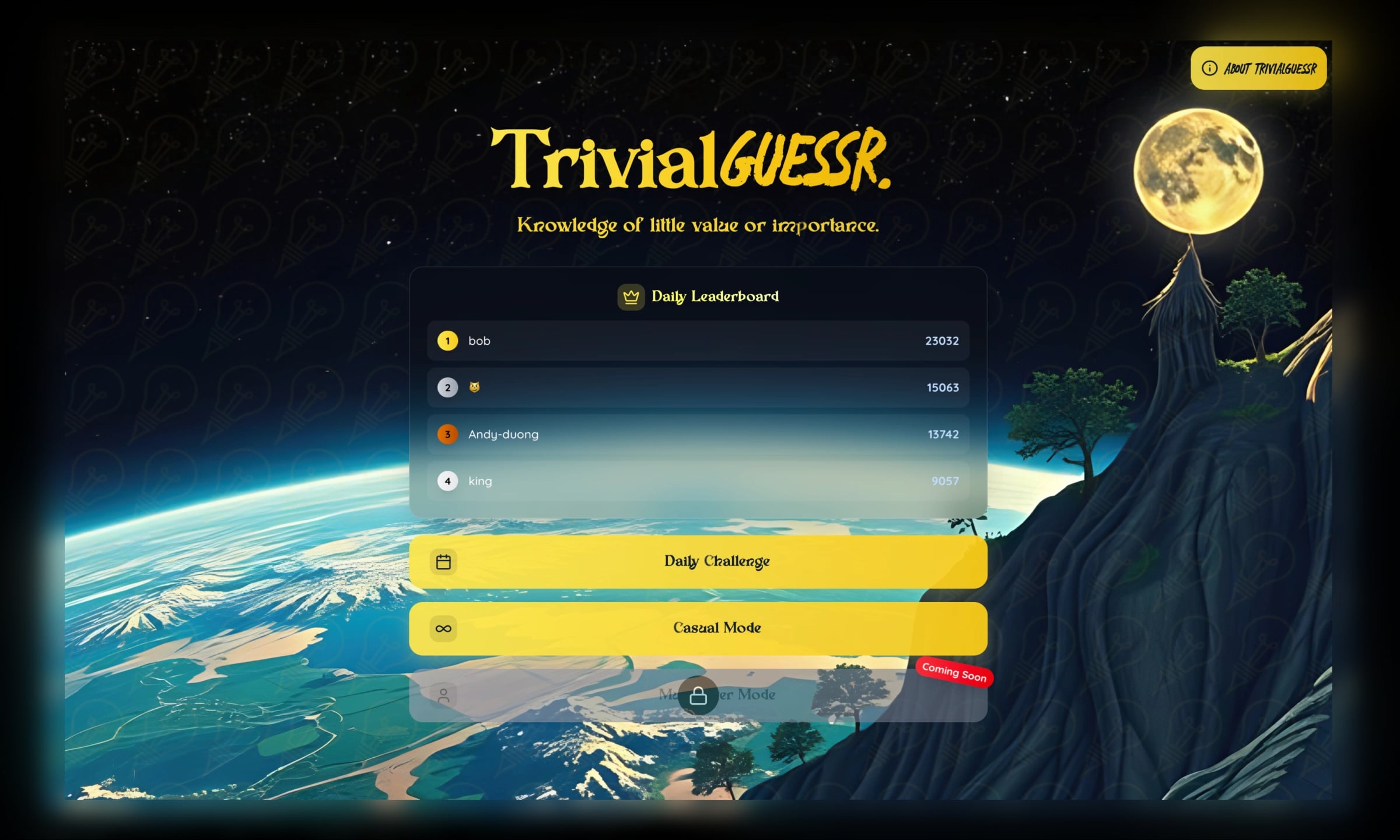
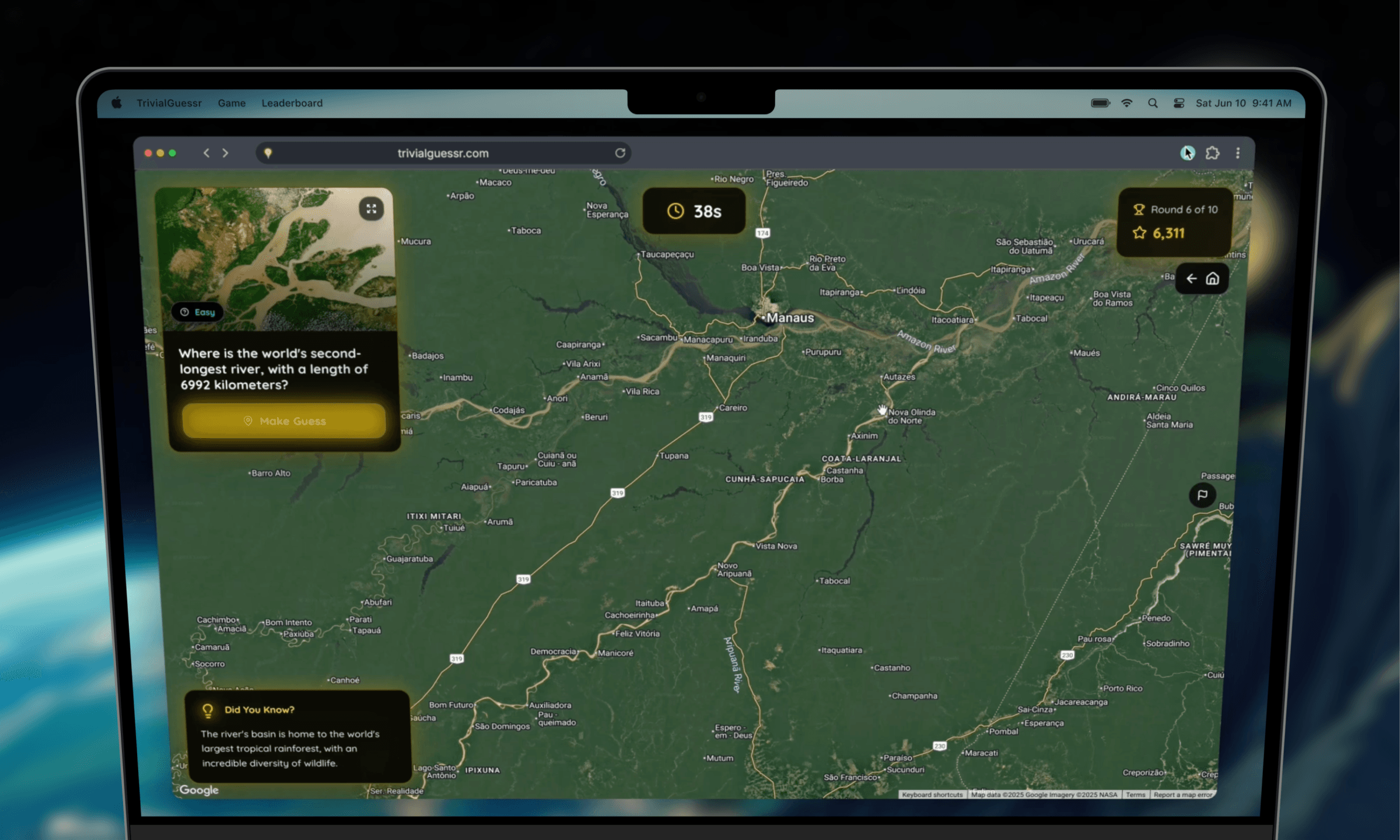
trivialguessr is geoguessr for trivia. questions are interesting trivia problems that can be traced to a specific coordinate of the world. grew to 500+ users, 2k events, and a peak of 60 active users a day.
andy and i wanted to ship something fast at the beginning of our 1a term. i always see takes on geoguessr, like watguessr for uwaterloo locations, so i thought i'd create one for trivia.
i really wanted the app to have fascinating questions regarding the world, not mundane trivia. simple wording like "plot the capital of germany" or "find the tallest mountain in the world" wasn't going to cut it.
i found that multi-layered wording combines pieces of one's world knowledge together, such as: "find the location of where 100 rusted, graffiti-covered british-imported steam locomotives and hollowed train cars sit half-buried in the desert sand, 3km outside the edge of the world's largest salt flat". so i designed all questions around this framing.
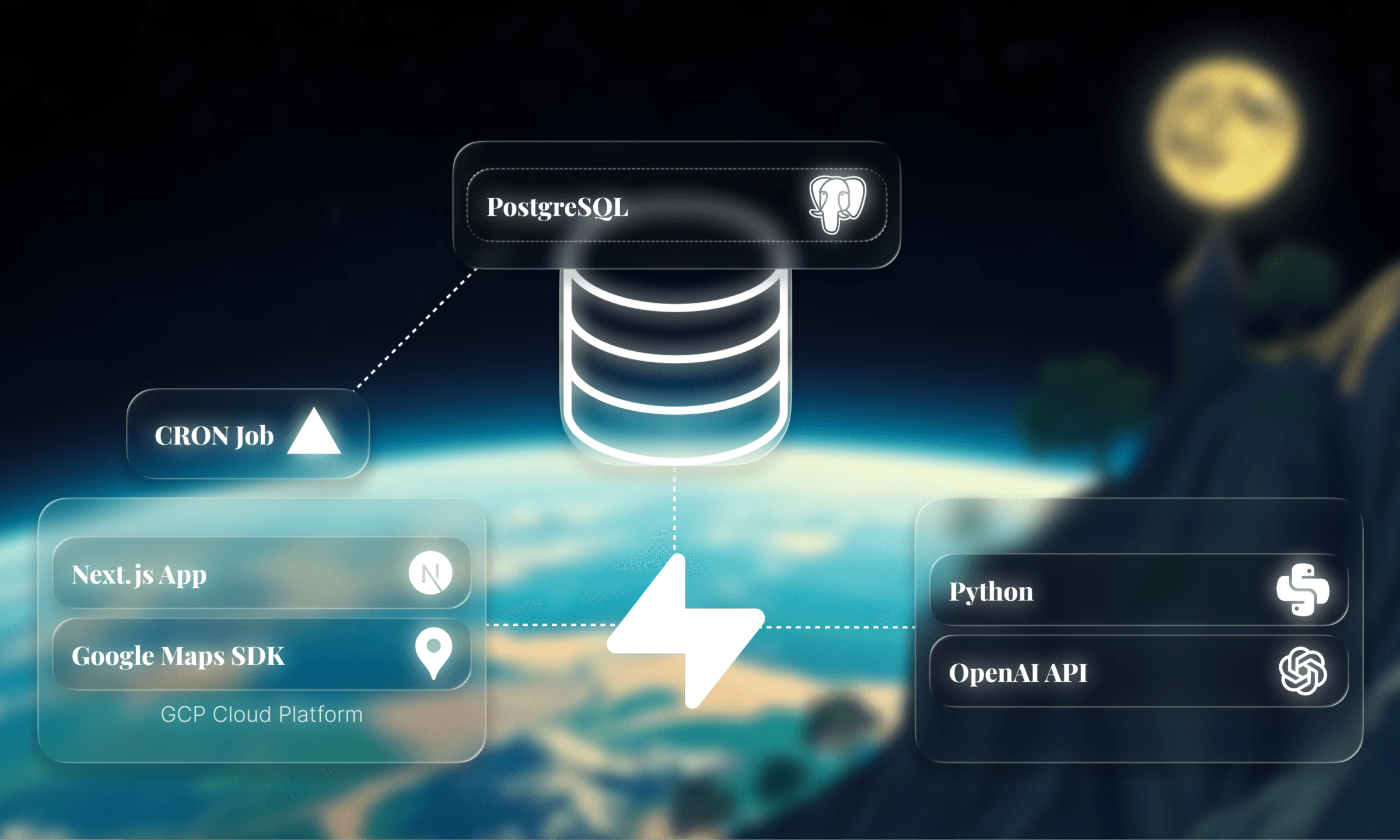
the architecture was extremely trivial itself. all that was needed was a next.js web app with gcp for google maps sdk, and supabase for postgres.
the question generation pipeline was a simple llm script + image scrape with python.
every day, a new daily challenge is auto-generated. users can play anonymously and see if they can crack the leaderboard.
it's impossible to stop users from playing multiple times with no auth, but a local state was implemented for peace of mind, so technically you could only play the daily challenge once.
the daily challenge data needs to be cleared every day at 12am est. this is done with a vercel cron job:
client/vercel.json{
"crons": [
{
"path": "/api/questions?action=daily-replace&limit=5&cron_secret=$CRON_SECRET",
"schedule": "0 5 * * *"
}
]
}
the cron job triggers two tasks related to the daily_leaderboard table and the daily_questions table:
clearing the leaderboard tablematches all rows and uses the delete() function.
server/index.tsapp.post("/api/delete-table", async (req: Request, res: Response) => {
const { tableName } = req.body;
await supabaseAdmin
.from(tableName)
.delete()
.neq("id", "00000000-0000-0000-0000-000000000000"); // guaranteed to match all rows
return res.json({ success: true });
});
this has to be done through the server because delete functions require admin permissions that cannot be granted client-side.
resetting the question tableuses delete and insert logic rather than a replace. first, it would call /api/delete-table.
then it would select 5 random questions from the pre-existing question bank.
this is safe to do client-side, so it was thrown into a next.js dynamic route. the logic is straightforward, with additional secret validation to restrict access to authorized cron callers only.
client/app/api/[table]/route.tsconst secret = process.env.CRON_SECRET;
const headerSecret = request.headers.get("x-clear-secret");
const authHeader = request.headers.get("authorization");
const authSecret = authHeader?.replace("Bearer ", "");
if (
headerSecret !== secret &&
authSecret !== secret &&
cronSecret !== secret
) {
console.log("Unauthorized attempt - invalid secret");
return NextResponse.json({ error: "Unauthorized" }, { status: 401 });
}
// ... clear table and replace questions
a python script generated ~1.5k unique questions. this was harder than it sounds because the number of duplicates was mind boggling, and many questions lacked excitement:
main.py calls the openai api to generate trivia questions, then scrapes images from bing, with wikipedia as fallback. the script includes anti-blocking measures like rotating user agents and adaptive delays.
scripts/main.pydef _adaptive_delay(self):
"""Implement adaptive delays based on success rate"""
self.request_count += 1
# Base delay with jitter
base_delay = random.uniform(3, 6)
# Increase delay if success rate is low (possible blocking)
if self.request_count > 10:
success_rate = self.success_count / self.request_count
if success_rate < 0.7:
base_delay *= 2 # Double delay if success rate below 70%
logger.warning(f"Low success rate ({success_rate:.2%}), increasing delays")
# Add extra delay every 100 requests
if self.request_count % 100 == 0:
base_delay += random.uniform(10, 20)
logger.info(f"Request #{self.request_count}, taking extended break")
time.sleep(base_delay)
a self-adjusting rate limiter was implemented to monitor its own success rate in real-time.
when detection risk increases (success drops below 70%), it automatically
doubles delays to evade bot detection. the scraper gets blocked after ~50 requests, but with
this logic, the app can successfully process 1000+ images per session.
 1.5k+ unique questions!
when generating questions, checking for duplicates during generation would require scanning the entire database for each new question. this is extremely memory and time intensive. instead, the app uses batch deduplication:
remove_duplicates.py runs periodically to clean the database, using difflib.SequenceMatcher for text similarity, geopy distance for coordinate proximity, and semantic analysis for questions about the same location with different wording.
andy and i tried to make the game as intuitive as possible. measures such as a report question button for users to report faulty questions were added to the product. the reported questions are investigated manually.
many improvements could be made to the game. multiplayer mode, audio and video questions, and auth could all be implemented in the future.
honestly, the architecture and pipeline for trivialguessr aren't very technically challenging at all. you can say that the project is very trivial. i just wanted to ship a fun concept quickly.
i learned a lot about cron jobs and web scraping and will continue to build cooler things in the near future.